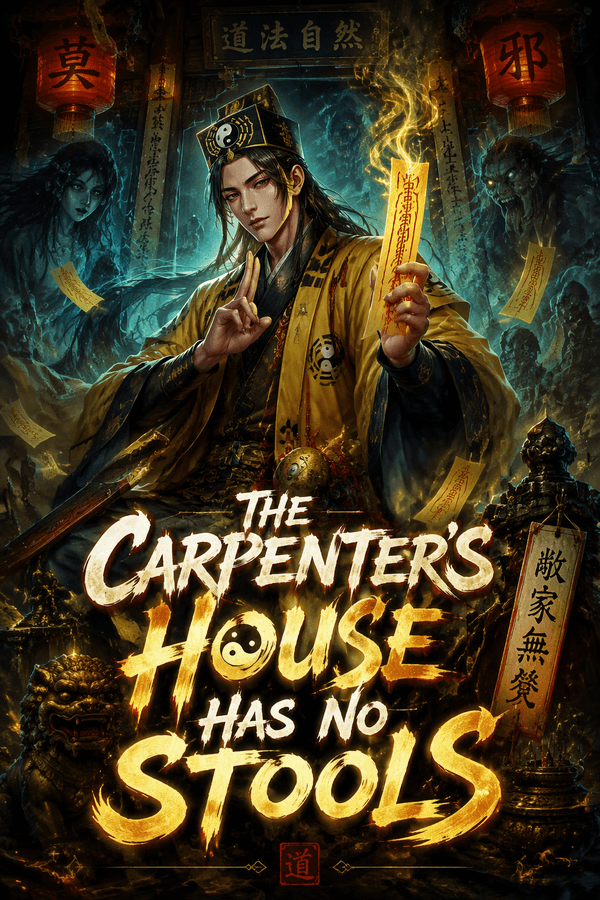
I, Jiang Honggui, am a half-baked Daoist.
Why half-baked?
To become a genuine Daoist, one must "take refuge in the Three Jewels." Taking refuge in the Three Jewels is the first step for anyone entering the Daoist faith.
The "Three Jewels" in which Daoists take refuge refer to the Dao, the Scriptures, and the Masters—full names being: "Taking refuge in the Supreme and Boundless Great Dao," "Taking refuge in the Thirty-Six Chapters of Venerable Scriptures," and "Taking refuge in the Great Master of the Profound Mysteries."
I don't believe in any of that.
I believe I am one simply because I say I am.
Speaking of this, the story must start with my grandfather's generation.
My grandfather belonged to the "Chun" generation of the Jiang family. He was the eldest of eight siblings and went by the nickname "Big Gun Jiang." In his youth, he studied at Yangzhou University and was an unadulterated college student.
College students back then weren't like today, where you can find a dozen on every street corner. In that era, producing a single college student for miles around was considered a sign of smoke billowing from one's ancestral graves.
Later on, due to some unknown turn of events, the only college student for miles around failed to remain in Yangzhou. He returned crestfallen to his hometown to work as a schoolteacher.
From the time I was little, my grandfather loved me the most. When he wasn't teaching, he kept me by his side every day, taking me along to watch him play mahjong.
When he wasn't playing mahjong, I would constantly pester him to tell me stories, especially loving tales of ghosts and gods.
My grandfather seemed to have an endless reservoir of stories in his belly. Almost every day, without repetition, he would tell me novel tales that had me chuckling with delight.
After hearing so many stories, certain characters and plots stuck in my mind.
Even now, though I've forgotten most of them, I remember one specific place.
Yangliu Taoist Temple.
Why would I remember such a place?
Because whenever my grandfather got carried away with his stories, he would say, "Back in the day, when your grandfather was at Yangliu Taoist Temple, I did this and that, learned this and that, and ended up such and such."
Over time, it stuck in my head.
Later on, as I grew a bit older and started school, my grandfather retired from teaching. He spent his days smoking, playing mahjong, and teaching me to read and write.
Such peaceful days lasted only a few years before my grandfather's health failed.
According to the doctor, it was late-stage esophageal cancer, and something about smoking—anyway, he was beyond saving.
It dragged on until I was in the fourth grade. That afternoon during an exam, my dad suddenly came to school, spoke to the teacher about something, and then took me away.
As soon as I got home and saw the scene inside, even someone as dense as me understood. I grabbed my grandfather's IV-swollen arm and wept bitterly.
Weeping was of no use.
Grandfather stroked my head one last time, smiled, and passed away.
Afterward, everything proceeded by the book: hiring people to perform funeral rites, notifying relatives far and wide. Everyone gathered together to burn paper money and keep vigil, which goes without saying.
Though I was grieving at the time, I was also extremely curious.
Why must the placement of the furniture be rearranged after someone passes away in the house?
At the time, I simply thought it was to keep people from being reminded of the deceased and yearning for their loved ones.
Later on, I learned that only the bed needs to be moved; all other furniture is merely shifted in accordance with the new position of the bed.
A person spends at least half their life in bed. The ancients believed the bed was where the deceased's soul lingered. Dismantling the bed or moving its location allows the deceased to reincarnate into the Underworld sooner and rest in peace.
Once my grandfather's funeral was over, everything settled down.
What truly affected me was when the family called me over to help sort through his leftover belongings, and I accidentally discovered some of my grandfather's notes.
Being young then, I simply assumed they were course notes left over from his many years of teaching. Figuring my grandfather was a high school teacher after all, the notes must contain plenty of study materials and knowledge points, so I kept the notebooks, and as time passed, I forgot all about the matter.
People experience a sudden awakening at a certain age. I didn't quite understand what it was, only that one day, knowledge in textbooks suddenly felt so simple, and I couldn't mesh with my peers anymore because I found them childish.
Under these circumstances, I became somewhat reclusive. Having nothing to do in my spare time, I no longer wanted to go out and play. Instead, I rummaged through boxes and cabinets at home, wanting to study books meant for adults.
I remember finding a book back then called *Temptation of Wolves*. Seeing the word "wolf," I thought it must be a really cool book, but after finishing it, I discovered it was a Korean romance novel—phui.
While rummaging around like this, I dug out my grandfather's notes.
Opening the first page, I was stunned.
The book didn't contain advanced academic knowledge as I had imagined, but rather esoteric and difficult sentences, accompanied by incomprehensible illustrations and dense annotations.
An ordinary person seeing such things would likely have shoved them under the bed to gather dust, used them to kindle a fire, or at best, thrown them into the recycling pile to add a bit of weight.
But I was stubborn and reclusive back then; the harder something was to understand, the more stubbornly I insisted on reading it.
If I couldn't understand it in a day, I would read it again the next, determined to figure it out.
I don't know how much time passed, but while I only half-understood the book, I had reached the point where—much like reciting three hundred Tang poems—even if I couldn't compose poetry, I could still chant it.
I didn't understand the meaning of the content in the book, but I could memorize it.
The very first page of the notes began with: "Heaven and Earth Xuanzong, Origin of Myriad Qi. Cultivating through kalpas countless, verify my divine powers," and so on. I didn't know what it meant at the time, but I later learned this trick was called the Golden Light Incantation.
Similar ones included: "Supreme Polestar, responding without pause, driving away evil and binding specters, protecting life and guarding the body," which was the Calm-Heart Incantation.
"Origin Lord pacifies and stabilizes, proclaiming to all spirits, true officials of peaks and torrents, local divinities," which was the Earth-Pacifying Incantation.
There were also the Mouth-Cleansing Incantation, the Purification Incantation, the Heaven and Earth Exorcism Incantation, and so on, which I won't list exhaustively here.
In short, I could memorize them, but I didn't know what they meant.
I once tried going out to play with my little friends, pinching hand seals and muttering incantations under my breath, imagining myself as an almighty demon king chanting obscure and difficult spells to make my friends submit and prostrate themselves at my feet.
Then I got beaten up.
They said I was acting crazy and thought I was possessed by a ghost.
One of those friends even ran to the toilet, scooped up a basin of shit-water, and threatened to pour it down my throat, claiming he'd heard from the elders that if someone went out of their mind, a ladle of shit-water was guaranteed to cure them.
From then on, I became even more taciturn and disinclined to go out and play, terrified that my friends might take it into their heads one day to feed me shit-water again.
Consequently, I holed up at home all day long, reading, studying, and playing video games, while flipping through my grandfather's notes in my spare time.
Besides various incantations, those notes contained quite a few talisman patterns. With nothing better to do, I copied the designs, tracing the gourd according to the pattern, and learned to draw them quite decently, truly spending an incomparably fulfilling childhood.