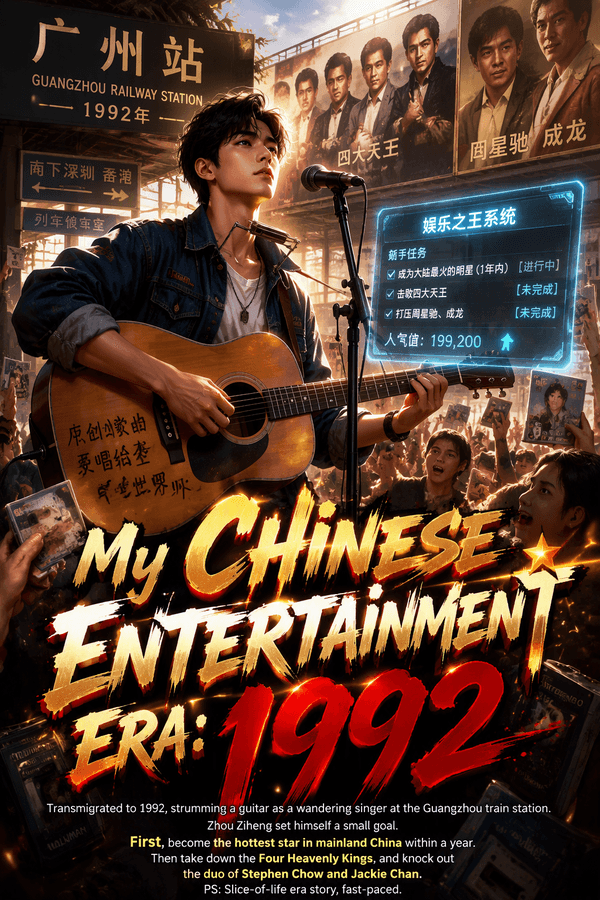
(Entertainment fiction; please do not take any persons or events in this story as real.)
June 1992.
The summer solstice in Yangcheng ushered in a scorching season; even the breeze carried a damp, sweltering heat.
"Clatter, clatter... whoo-whoo..."
A faint breeze slipped through a crack in the window, carrying the chaotic noise of trains departing from the nearby station.
Mixed with it was the sound of the era’s "Little Tigers" singing, "Take your heart and my heart, string them together like a four-leaf clover, string them into a concentric circle..."
In the room, Zhou Ziheng lay flat on his bed, staring blankly at the ceiling.
He had been reborn.
He had come back from 2025 to 1992.
He had transformed from a post-00s university student into a twenty-year-old "Southern Drifter" born in 1972.
A single crack of thunder had plucked him from an era of food and clothing security, convenient travel, and browsing TikTok to flirt with girls, and dropped him into an age devoid of mobile phones and the internet, where many places still relied on black-and-white televisions.
What was one supposed to do after being reborn into the nineties?
Zhou Ziheng pondered it over and over.
Follow the "small goal" and go into real estate?
He had no capital!
Trade stocks like Bao Zong in *Blossoms Shanghai*?
He couldn't even figure out what the Shanghai Stock Index was.
Go into the internet business and steal the opportunities from the Ma brothers?
To hell with that! Asking a music conservatory student to build the internet in the nineties was probably as difficult as asking him to hand-forge a nuclear bomb.
After thinking it over, it seemed he had to stick to his previous life's plan: entertainment was the way to go. Singing was the proper path.
It was a perfect match for his professional training.
Moreover, this body had decent looks and a good singing voice.
With it being the early nineties, the mainland pop music scene was just beginning to take off. Music cassettes were selling like hotcakes, often hitting sales in the millions. Not singing would be an insult to the stack of pop hits in his head.
However, after a careful look at the situation, Zhou Ziheng felt quite helpless.
In this era, wanting to become famous or make a name for oneself wasn't that simple.
In the mainland right now, there were only two paths for an aspiring singer.
First, participate in the Young Singer Grand Prix and join the "National Team."
Second, become a resident singer—commonly known as a wandering singer—and attract the attention of a record label.
Both paths were extremely difficult.
As for participating in the Young Singer Grand Prix, whether one could break out from the crowd of "National Team" members was one thing.
The real issue was qualifying.
How should one describe the Young Singer Grand Prix at this time?
It was the true National Team.
Participants first had to be members of regional cultural troupes; for a grassroots performer to break out there was harder than ascending to heaven.
As for being a resident singer to attract a record label...
Honestly, that was equally difficult.
Since the late eighties, the waves of pop from Hong Kong and Taiwan had been blowing in, and across the motherland, it wasn't just the cultural troupe members who could sing or wanted to.
There were plenty of restless souls and great voices, but the stages where one could shine were few and far between.
In fact, there were fewer than ten satellite television stations in the entire country, and none of them were even broadcasting via satellite yet.
Those who wanted to sing but couldn't enter the Young Singer Grand Prix naturally set their sights on smaller stages like cabarets.
Countless people with voices like angels across the country had become wandering singers, working as residents in dance halls.
With few opportunities and fierce competition, this path was fraught with hardship.
The original owner of this body had been a resident singer at the Friendship Salon Cabaret for over half a year and hadn't gotten a single chance—he hadn't even caught a whiff of anyone from a record label.
"I’ll sing 'Wandering Song' tonight. If there’s still no hope, it looks like I’ll have to head to Hong Kong and Taiwan to fight for scraps with the Four Heavenly Kings!"
Sighing, Zhou Ziheng sat up.
Truth be told, unless necessary, he didn't want to go to Hong Kong and Taiwan.
It wasn't that he’d never go.
But going as a wandering singer wouldn't be any easier than staying in the mainland.
Don't be fooled by the fact that stars from Hong Kong would later flock to the mainland in droves, all talking about "one big family."
Right now, you could forget about that.
Unless you had major connections, a mainland singer or actor trying to make it in Hong Kong and Taiwan would naturally be excluded.
Being excluded was one thing, but being treated differently was worse.
Mainland actors and artists in Hong Kong and Taiwan weren't just treated differently in terms of status; their compensation was the same.
If a local could earn a hundred dollars for a job, a mainlander would get less than a tenth of that.
In short, if he went to Hong Kong and Taiwan, he wouldn't just struggle to make it—if he did manage to break through, he’d have to endure sneers and suffering.
So, unless he truly couldn't survive in the mainland, Zhou Ziheng wouldn't consider it.
*Knock, knock, knock!*
The door was rapped on.
"Hahaha! Ziheng! I did it! Mr. Li Guangping from the China Record Planning Department heard my 'Xiaofang.' He approved of my song, and he’s coming tonight to talk to me about releasing it!"
Outside, the person knocking spoke with unrestrained excitement.
Zhou Ziheng crawled out of bed and opened the door.
Standing outside was a sturdy, honest-looking young man. He squeezed into the room, saying excitedly:
"Ziheng, do you know about the China Record Planning Department? It’s the first department in Yangcheng established with a model inspired by Hong Kong and Taiwan companies. They’re recruiting singers nationwide. If they take a liking to a singer, they sign them just like they do with Hong Kong stars, planning their future and packaging them."
At these words, a glimmer of memory flashed in Zhou Ziheng’s eyes.
Of course he knew about the China Record Planning Department.
Anyone who studied pop music wouldn't be a stranger to this.
This was truly a major milestone in the history of mainland pop music.
It was precisely in 1992 that Guangdong musicians, borrowing from Hong Kong, Taiwan, and international practices, pioneered the record company planning department and producer system in the mainland: the label would sign the singer, and the producer would tailor songs, define the artist's brand, and conduct promotional campaigns, all after careful packaging before the release.
This commercialized, market-oriented operation, which followed global trends, allowed Guangdong’s pop scene to flourish and become the center of mainland pop music at the time.
At the same time, it gave birth to the later-famous "94 New Generation."
The so-called "94 New Generation" referred to the first generation of mainland pop stars reaching their peak in 1994.
In the south, there were Mao Lin, Yang Yuying, Li Chunbo, Gan Ping, and Chen Ming; in the north, there were Chen Lin, Xie Dong, and Sun Yue.
There were also Lin Yilun, Huofeng, Gao Linsheng, and other star singers who were equally explosive nationwide in 1994.
This group created a brilliant era; they were the brightest stars in the mainland market, in no way inferior to Hong Kong and Taiwan singers—they were the first truly homegrown icons of the mainland.
"Congratulations! It looks like it won't be long before you leave this place and become a singer in the truest sense!"
Although Zhou Ziheng was envious, he felt no jealousy and smiled to congratulate the man, who was nearly a dozen years older than him.
This man was none other than Li Chunbo, who would soon become a nationwide sensation with "Xiaofang," filling every street and alley with his voice and turning 1993 into his own year.
Zhou Ziheng hadn't been too familiar with Li Chunbo in his previous life, mostly because he retired from the music industry very early to go into filmmaking.
The only thing Zhou Ziheng knew was that "Xiaofang" was a genuine mega-hit.
Some might call the song "tacky"—both then and in the future—but one couldn't deny it was a massive success. Two months after its release, it sold over a million copies, and the line, "There's a girl in the village named Xiaofang," became a tune that everyone in that era could hum.
By coincidence, after being reborn, he discovered he and Li Chunbo were both resident singers at the same cabaret.
Although there was a nine-year age gap, because they lived next door to each other and both enjoyed holding guitars and working on original music, they became close friends.
"Haha!" Hearing the congratulations, the joy on Li Chunbo’s face was undisguised. "I knew this song had potential! Which cabaret guest doesn't like it? I pitched it to other labels before, and they wouldn't take it—they had no vision!"
His expression turned serious as he looked at Zhou Ziheng. "Ziheng, aren't you tinkering with a new song lately? I heard a bit through the wall, and I personally think the quality is very impressive.
When the folks from the China Record Planning Department come tonight, I’ll find a way to make them stay a little longer.
You should sing that song when you get on stage. If you’re lucky enough to be spotted and signed, there will definitely be plenty of opportunities to make big money in the future!"
"Thank you! I’ll definitely strive for that opportunity," Zhou Ziheng said with a note of solemnity.
He knew exactly how important this chance was.
The China Record Planning Department! That was one of the big four record labels in Guangdong.
Li Chunbo was someone who loved to share.
Having his song recognized by the department was a huge deal, so naturally, he had to go share it with others. After chatting for a few more minutes, he rushed out of the room to bother other acquaintances.
Zhou Ziheng checked the time; it was already one in the afternoon. He didn't go back to bed, but instead washed up, picked up the old guitar the original owner had left behind, and headed out.
"How to face the days we walked together? Now I’m left to walk alone. How can I let you know my inner voice..."
"Going out to sing again, Ziheng?"
In the security office of the compound, the theme song Liu Dehua sang for *Casino Raiders II* last year played on a tape recorder.
Old Wang, the security guard who was enjoying the music, glanced at Zhou Ziheng, who was carrying his guitar, and greeted him.
"Yes, Brother Wang! Gotta earn my keep!"
Zhou Ziheng greeted Old Wang back and walked quickly out of the compound.
Though called a compound, it was essentially a hotel—Friendship Hotel, the largest one near the Yangcheng train station.
It contained a restaurant, lodging, a cabaret, and various other facilities.
Zhou Ziheng was a resident singer at the cabaret there, living in the dormitory building in the back and performing in the cabaret at night.
During the day, he would take his guitar and go sing on the commercial street of Nonglin Lower Road.
Well, it was basically busking.
He’d place a box for money in front of him, hug his guitar, and sing for an hour or so. If he sang into the hearts of passersby and met someone generous, they would tip him a few yuan. By the end of the day, he could earn over ten yuan.
Combined with his job at the Friendship Salon Cabaret, he could bring in about a hundred yuan a day.
In the economic environment of this era, this wasn't a low income.
Actually, it could be called a high income.
But he couldn't help the heavy economic pressure on this body.
They say all time-travelers are orphans, and that was certainly true.
When Zhou Ziheng arrived in this body, his parents had already passed away.
Not only had they died, but they had also left him with a massive debt.
The original owner’s parents were among the first to "dive into the sea" of business.
During the early days of the Reform and Opening-up policy, relying on policy advantages and a good industry choice, they had earned a good deal of money and became "ten-thousand-yuan households."
That was why the original owner had a good musical foundation; in this era, if you didn't have money, playing music was a pipedream.
However, their good life ended a few years ago.
In 1989, the country experienced its second economic crisis since the Reform and Opening-up. In this crisis, the company his parents operated not only collapsed but left behind a massive debt of over one hundred thousand yuan.
A hundred thousand seemed like a small amount in the future, but in this era, it was a staggering sum.
To repay the debt, the couple worked from dawn till dusk. Two years ago, on a night when they were out late for a business banquet, they were involved in a landslide and both left this world.
After they passed, the massive debt fell squarely onto this body.
Creditors showed up, relatives demanded payment.
To pay off the debt, the original owner sold everything he could, but it wasn't enough.
In the end, to pay his debts, he chose to come to Yangcheng to become a resident singer.
To this day, Zhou Ziheng still carried a debt of over seventy thousand yuan.
Most of it was owed to relatives.
Every month, Zhou Ziheng had to send a sum of money back home.
Therefore, even though his daily income wasn't low, for Zhou Ziheng, it was just a drop in the bucket.
"Fried noodles!"
"Rice noodles, delicious and cheap rice noodles! Come take a look, come see!"
"Dongguan, heading to Dongguan!"
"Tianhe, Tianhe passengers, get on!"
The Friendship Hotel was close to the train station, not far from the exit, and the flow of people was explosive every day. Today was no exception, as one outsider after another, carrying large bags and luggage, walked out of the station with exhausted expressions.
When they saw this increasingly modernizing Yangcheng, excited looks appeared on their faces, as if arriving in this city meant they were on the road to wealth.
This scene couldn't help but make Zhou Ziheng sigh.
Starting in the eighties, the spring breeze of reform first warmed the south. The catchy slogan "East, West, South, North, and Center, go to Guangdong to get rich" spread across the land, and people flocked south, carrying their luggage.
Yangcheng Railway Station became the first gate facing the incoming tide.
It attracted countless people clutching their dreams.
They arrived with their bags and luggage.
Some became the trendsetters of the era and eventually found success.
Others were battered and bruised, leaving with nothing.
Among those in front of him, some might succeed, but most would likely leave behind only a trail of sad memories.
While waiting for a ride, Zhou Ziheng’s gaze fell on a barbershop nearby.
The sun shone directly onto the advertising sign, reflecting a faint light.
[Trendy Haircut]
On the shop’s glass were posters of all the most stylish celebrities of the day.
Perhaps due to wind and sun, the photos of Leslie Cheung, Alan Tam, Jackie Chan, and Anita Mui were slightly faded; the newest ones were of the Four Heavenly Kings, like Andy Lau and Aaron Kwok.
This seemed to signal that the Hong Kong entertainment scene was also changing of the guard.
But regardless, nothing could change the fact that in Yangcheng, Hong Kong and Taiwan stars were still the most popular.
Just how popular were Hong Kong and Taiwan stars in Guangdong?
Let’s just say this: the Four Heavenly Kings released a new song in Hong Kong yesterday, and by today, every major cabaret in Yangcheng had singers covering it.
It wasn't just "popular" in the ordinary sense; it was viewed as a trend, a momentum.
Hong Kong and Taiwan meant fashion; they meant trends.
Whether it was clothing, film, or music, this was the case.
His eyes lingered for a long time on the photos at the entrance of the barbershop. Zhou Ziheng hoped that one day, his own photo would hang alongside the Four Heavenly Kings, becoming a symbol of what was "trendy."
Only then would it be worth all the future classics he carried in his mind.