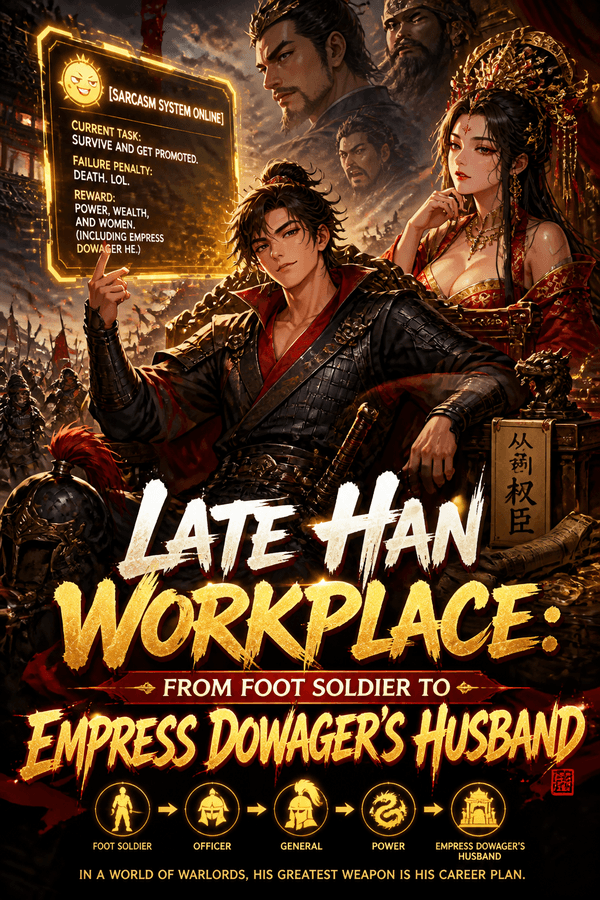
The sunlight slanting through the corridor cut across the blue brick floor. Yan Gan strode quickly, holding his sword, the hem of his black battle dress brushing against the moss on the steps. When he encountered guards on duty, he cupped his hands in a salute.
A bearded guard raised his chin in response. The one across the hall, however, kept his eyes down, like a rusted Buddha statue. Yan Gan paid no mind to this, for it was his principle of conduct.
Whether you are polite or not, I do not care. What I care about is that I must not lose my own etiquette. For a moment, he tightened his grip on the sharkskin scabbard of his sword and continued forward.
Pomegranates were shedding their blossoms by the gate. Li Yi had just come out and, seeing him approach, stepped forward to greet him: "Lord Zheng was just looking for you, why are you here?" "Brother Yi."
Yan Gan first cupped his hands in greeting before speaking. "I have something to report to Lord Zheng." "Mm, go on.
Lord Zheng's complexion is not good." Yan Gan tidied his robes, took off his boots, and then stepped over the threshold. Passing the screen wall, he saw Zheng Da sitting at the desk in the main hall.
Yan Gan hurried forward a few steps. As he got closer, he quickly bent his knees and knelt to salute: "Your servant Yan Gan, pays respects to Lord Zheng." Ancient people were accustomed to self-deprecation in their etiquette, so many from aristocratic families would refer to themselves as servants or slaves when serving their lords.
Zheng Da, behind the desk, did not look up. His knuckles tapped the desk, making the bamboo slips on it rustle. After performing his salutation, Yan Gan knelt to the side, remaining silent.
"Geng Bi is conscripting the Six Commanderies' troops to quell the rebellion. What do you think?" Zheng Da suddenly spoke after a long pause.
Yan Gan's Adam's apple bobbed, and he did not answer directly. Sweat had inexplicably broken out on the back of his neck. "Zhang Wen previously led Dong Zhuo and Zhou Shen's forces to defeat the rebels, and was promoted to Grand Commandant based on this merit," Zheng Da continued.
"Now, Geng Bi, the Inspector of Liangzhou, is conscripting troops from the Six Commanderies, which Zhang Wen has strongly advocated for. If the rebels can truly be wiped out, his merit will surely surpass that of the Grand General. What do you say, should the Grand General's Estate get involved to share some of the credit?"
Zheng Da then added, "I only fear that if the rebellion cannot be quelled, it will make the Grand General's Estate appear incompetent." Hearing this, Yan Gan was inwardly thrilled. Such state secrets, and Lord Zheng was actually consulting him – this meant he was being treated as a confidant!
However, on such a major matter, Yan Gan could not make up his mind at once. His mind began to race, calculating rapidly. But due to the lack of frontline information, such matters were like gambling.
Whether he won or lost, if he won, Yan Gan would soar to success and completely become Zheng Da's confidant. If he lost, he would undoubtedly be made a scapegoat. A beheading and public display would be certain.
Thinking of this, Yan Gan suddenly understood that Lord Zheng was also gambling. On such matters, Lord Zheng must have inside information, yet he had not shared it with him, indicating that Lord Zheng himself already had a judgment. It was just that at this moment, he needed to hear opinions from those around him.
If his opinion matched Zheng Da's, it would be satisfactory, and he might be promoted if successful, or killed if unsuccessful. If his opinion differed from Zheng Da's, he would be dismissed, and Zheng Da would find someone else to ask. Perhaps Zheng Da had already heard two opinions from his subordinates.
In any case, win or lose, someone would bear the blame. Zheng Da would simply say, "Regrettable that I didn't listen to so-and-so's advice." Looking further up, wasn't the Grand General the same?
For any matter, he would always hear various opinions. Once Yan Gan understood this, he naturally was unwilling to rashly offer his personal opinion. The higher-ups might just be looking for someone to scapegoat, but if he lost, he would pay a heavy price, ranging from a ruined career to certain death.
He had to give the correct answer. Yan Gan could feel the sweat on his back sliding down his waist: "Lord Zheng..." He licked his dry lips.
"This is a matter of national importance. Your subordinate needs to first gather some military intelligence from the border regions before presumptuously commenting." Zheng Da's knuckles stopped tapping the desk.
His gaze swept over Yan Gan's tensed shoulders, and he suddenly let out a scoff: "That's reasonably prudent." He took a sip of cold tea. "What was it you wanted to report earlier?"
"It's about the retainer troops at Chun Garden." Yan Gan breathed a sigh of relief and straightened his back. "While training, your subordinate saw several promising individuals, especially the squad leader named He Fang.
He is literate and has a good grasp of formations. Should we...?" "Currently, people from Guandong hold the majority of positions in the court.
Others, whether from Guanzhong, or further afield like Shudi or Youzhou, must rely on actual achievements to speak," Zheng Da interrupted Yan Gan, tapping his fingertip on the map on the desk. "Therefore, just do your best. Don't worry about other things.
Considering gains and losses will be something for you to ponder when you reach a high position." "I shall heed my master's teachings." This time, Yan Gan's kowtow was sincere, his forehead touching the bricks.
Watching Yan Gan's departing back, Zheng Da suddenly smiled, saying to himself, "Even Yan Gan knows to consider carefully before giving an answer. As a Consultant Zhonglang, why should I be impatient? Let the subordinate officials argue first."
Just then, Li Yi entered from outside and saluted Zheng Da. Zheng Da's expression relaxed, and he casually asked, "Geng Bi is conscripting the Six Commanderies' troops to quell the rebellion. What do you think?"
Li Yi replied, "In the past, when the Grand Commandant quelled the rebellion in Liangzhou, he struck them so hard that they fled like stray dogs, merely lingering outside the passes. Before, it was undecided, but the successive inspectors did not understand military strategy. Inspector Geng of Liangzhou is from a military family, well-versed in military strategy, and has achieved numerous victories.
This time, he has also conscripted the brave warriors from the Six Commanderies. It can be said he is using his full strength, like a tiger preying on a chicken. How could there be a reason for failure?"
Zheng Da nodded and said, "What you say is very insightful." ... In Chun Garden, beneath the old locust tree by the training ground, a crowd had already gathered.
Besides fifty household soldiers, several dozen servants had also gathered, and even a few maidservants were watching from afar. This was because there had been a major shift among the household soldiers. He Fang, the former squad leader, had been directly promoted to company commander.
He Lin, the original company commander, had been demoted to squad leader. When Yan Gan was present, He Lin dared not act out. As soon as Yan Gan left, he immediately shouted at everyone and began to pressure He Fang.
He Fang knew this would happen. As soon as he had agreed without hesitation, saying there was nothing to be afraid of, he had anticipated this. So, he proposed a competition, with each leading a squad of men.
If he, He Fang, won, He Lin would obediently listen. If he, He Fang, lost, he would explain to Yan Gan and resign his position as company commander. He Lin was overjoyed.
He had shouted at everyone precisely to humiliate He Fang. To make everyone realize that even if He Fang held the position of company commander, He Lin was still the one who mattered. In He Fang's words, in the unseen realm, the disgraced He Lin was attempting to establish informal authority.
After all, many theories are summarizations of practical experience. But He Lin had not expected that He Fang, so young, would, in a fit of anger, propose a competition. A competition?
Hahaha, never mind anything else, when it came to competitions, He Lin was definitely number one. Back then, facing the Moth Bandits, everyone was trembling like quails. If he, He Lin, hadn't taken the lead, the village would have been overrun and slaughtered.
If it were real swords and sabers, he would even dare to face He Fang's entire squad alone. However, since they were using wooden practice weapons, he naturally chose to be cautious. He personally selected several strong men who were on his side.
At this moment, both sides, each with ten men, began to form ranks under the gaze of the crowd. A crowd makes for a lively scene. He Lin's men were slapping their thighs and cheering, their wooden sabers pounding against the ground.
"Look at He Fang's unit's formation!" a man with a missing tooth pointed at the field. "He Dong is carrying the large winnowing fan, is he going to perform a rice-husking demonstration?"
"And those two simpletons, He Chun!" another person laughed uncontrollably. "They're using a pitchfork as a halberd.
I bet they'll go straight to digging fields after the battle?" Hearing these voices, He Lin's lips curled into a cold smile. On the other side, looking at the strong men led by He Lin, He Fang's men clearly lacked morale.
He Dong was already trembling: "Squad leader, how can we win this? Note: During the Eastern Han dynasty, the selection of officials was mainly based on the "recommendation system" (officials recommendation system). Those recommended (Disciple and Former Officials) formed a lifelong dependent relationship with their patron.
According to the Book of the Later Han: Gongsun Zan recommended a Shangji official. Prefect Liu Jun was impeached for an offense and taken away in a cage. According to the law, officials were not allowed to travel with their close associates.
Zan then changed his appearance and disguise, posing as a guard, and personally transported the prisoner to Luoyang. The prefect was to be transferred to Rinan. Zan prepared pork and wine on Mount Bei Mang, offered a sacrifice to his ancestors, poured libations, and said: "In the past, I was a son; now I am a subject.
I must go to Rinan. Rinan is full of miasma, and I fear I may not return. I will bid farewell to this grave forever."
He wept with emotion and, after bowing twice, departed, moving all who watched to tears. The biography of Yuan Shao in the Book of the Later Han states that the Yuan clan had "Disciple and Former Officials spread throughout the realm." These individuals were required to mourn their patron for three years (e.g., Wang Diao, a disciple of Li Gu, "submitted a petition with shackles to plead for justice"), and even continued to serve their patron's family after their death.
This obligation far exceeded ordinary bureaucratic relationships and was logically consistent with the loyalty of servants to their masters. The Han laws stipulated that "a former official who kills or injures his old patron shall have his punishment increased by one grade." This legal discrimination echoed the treatment of slaves and servants, where "a slave or servant who kills or injures their master shall be given the extreme penalty."
Zang Hong's father was Zang Min, the General Who Protects the Xiongnu. He was appointed a Boy Official by virtue of his father's merit and became well-known in the Imperial Academy, a true aristocrat. In his "Reply to Chen Lin's Letter," he explicitly addressed Yuan Shao as his master and referred to himself as a servant.
At this time, it was not too long before the system of enfeoffing feudal lords, and the Dual Monarchy Concept was prevalent. In addition to the lord-subject relationship between the Son of Heaven and all the people, the lord-administrator relationship between Prefects and Commandery Governors and their respective subordinate officials was also common. ...
Of course, it was not absolute. There were those who changed allegiances, such as Dong Zhuo, Lü Bu, and many others. However, under normal circumstances, loyal individuals or actions were more encouraged by the prevailing environment.