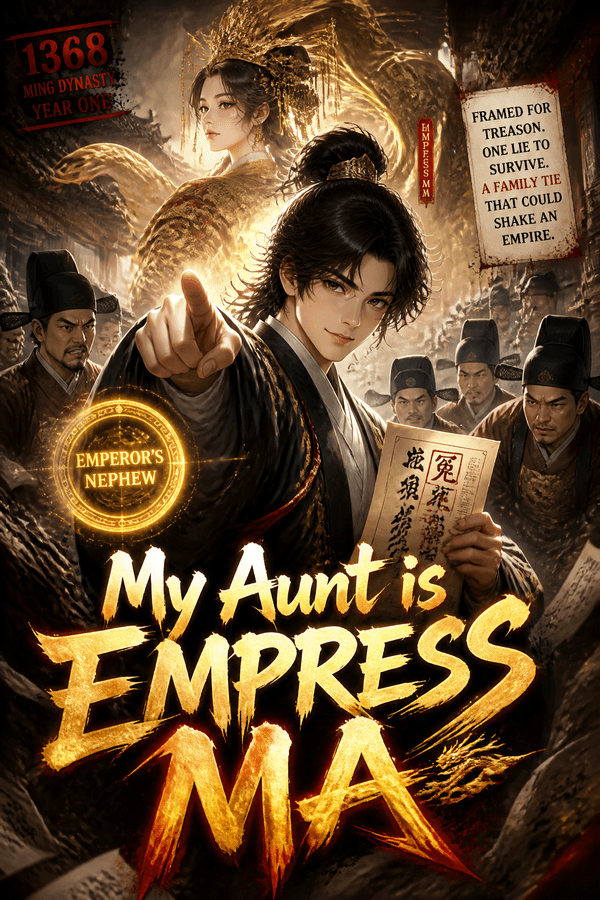
Inside the empty prison cell, Ma Yu lightly pinched a roasted soybean, tossed it into his mouth, and began to chew slowly, savoring the flavor.
The good times were coming to an end.
He didn't know whether to consider his situation lucky or unfortunate. His soul had transmigrated into the body of a beggar, only to discover he had arrived in the first year of the Hongwu era. As a veteran hater of the Ming Dynasty, he was utterly speechless. Of all the thousands of years of history, he had to land in the time of "Zhu the Butcher"—God truly must be blind.
When a crowd of refugees swept him along to Yingtian, he had been reluctant. *I am a Ming-hater; I would rather starve to death or drown in the Yangtze River than become a slave to the Zhu-Ming dynasty.* Yet, before he could even utter the words "this is actually pretty good" (a nod to his own hypocrisy), he was seized by the officials of Jiangning County and sentenced to death for murder. He knew clearly that he was being used as a scapegoat. As a wanderer without even an identity, death was inevitable; struggling would only bring more suffering. Thus, before they could even torture him, he confessed to everything.
But confessing was not the same as accepting his fate. He had prepared a "big move" for those corrupt officials. During the Ministry of Justice's review, he had impersonated a nephew of Empress Ma. As for why he didn't impersonate a relative of Zhu Yuanzhang... pfft, who would care to impersonate a relative of Zhu the Butcher?
Everything had gone according to plan; the corrupt officials of Jiangning Prefecture were wiped out in one fell swoop. To this day, whenever he recalled the shocked and hateful gazes of those corrupt officials, he felt an incomparable sense of satisfaction. As a prisoner of state, he had been transferred to the Yingtian Prefecture Prison. Initially, he thought he would suffer greatly, but then he ran into two "young masters" who were there to "experience life." Relying on his silver tongue, he had successfully persuaded one of them to provide him with protection.
Today, those two young men had been called away; he guessed their families had come to retrieve them. Without their care, his days in prison would likely become difficult. Forget about meat and fish; he probably wouldn't even have these roasted soybeans to eat anymore.
Thinking of this, he pinched another bean and tossed it into his mouth—savory, salty, and crunchy. He had never imagined that simple roasted soybeans could be so delicious.
Just then, footsteps approached. He turned his head in confusion to see a boy of thirteen or fourteen walking out from the corner. The youth had a square jawline, a high, blade-sharp nose, and an aura that was both scholarly and imbued with an indefinable dignity.
*A truly dashing young man,* Ma Yu couldn't help but think to himself.
This youth was none other than Zhu Biao. As Ma Yu looked him over, Zhu Biao was doing the same. His first impression was poor: skin dark as charcoal, a gaunt, thin frame, head shaved clean leaving only stubble, and wearing loose prison garb that looked pathetic and comical. He was nothing like the unruly or arrogant person he had imagined. But considering the fellow’s identity as a beggar, he felt a sense of clarity. Still... even if he were a young man from a wealthy family down on his luck, he shouldn't be in such a state. Could this Ma Yu really just be a beggar?
With this question in mind, he walked to the cell door, pushed it open, and entered.
Ma Yu raised an eyebrow, vaguely guessing the visitor’s intent, but he remained silent, simply watching the other person.
After entering, Zhu Biao cupped his hands in a formal greeting: "I am Li Wen. It is a pleasure to meet you, Brother Ma."
There is a saying: one does not strike a person who is smiling. Since the other party was so courteous, Ma Yu rose and performed a *chashou* (hand-clasping) salute: "I am... well, Ma Yu. A pleasure to meet you, Young Master Li."
It wasn't that he wanted to be eccentric; he simply knew that ancient customs like bowing or cupping hands involved specific gestures. Doing it wrong would invite mockery. As a transmigrator, he wasn't well-versed in these etiquette protocols. Fortunately, he had learned the *chashou* gesture from a television drama in his previous life and had practiced it. He had used it instinctively. While it was a custom from a previous dynasty and likely not in use during the Ming, using an ancient rite in an era that prized tradition was never a mistake.
What he did not know, however, was that Zhu Biao—who had been watching his every move—misunderstood the gesture. The *chashou* salute had originated in the Wei and Jin dynasties and flourished during the Tang and Song. When the Mongols took control, the high-ranking Mongol officials disliked complex etiquette, so it was gradually replaced by simpler bows and cupping gestures. Eventually, it had been largely forgotten, used only in private by ancient families or great scholars. Zhu Biao knew of it only because of his teacher, Song Lian. Seeing Ma Yu know and use the *chashou* salute, Zhu Biao concluded that he was certainly not of beggar origin.
Zhu Biao thought this to himself while remaining calm on the surface. "Pardon the intrusion; I hope you do not mind."
Ma Yu asked curiously, "Young Master Li, this is..."
Zhu Biao explained, "My younger brother, Li Wu, has received much care from you, Brother Ma. As his elder brother, I have come specifically to offer my thanks."
In Ma Yu's mind, the image of that handsome youth (Zhu Shuang) instantly appeared. Come to think of it, the brothers did share a certain resemblance. As for the other sturdy youth (Chang Mao)... that true playboy was immediately disregarded.
"Young Master Li, you are too kind. It is I who have been cared for; it is I who should be offering thanks."
The two exchanged polite pleasantries for a good while. Finally, Zhu Biao could hold back no longer and turned to the main topic: "My brother recently relayed some of your insights on state affairs, Brother Ma. I found them breathtaking, yet I have some doubts I wish to discuss with you, if you would permit it."
*So that’s it,* Ma Yu thought. This Li Wen hadn't come just to pick up Li Wu; he was here because of the things Ma Yu had said. As for the "relaying" business? That was for the birds. When Li Wu came to "experience life" in prison, his family surely had guards watching. Everything Ma Yu said was likely fed to his family immediately. The fact that the surrounding cells had been cleared out was likely their doing as well. What surprised him was that it wasn't an elder who appeared, but a boy of thirteen or fourteen.
Reflecting on Li Wen's demeanor, however, he calmed down. He must be the heir the family was grooming, perhaps even someone who had begun managing matters on his own. Plus, since he was also a youth, it might be easier for him to speak. He couldn't help but admire the family; they certainly knew how to do things properly.
As to whether he should answer the questions—well, he had eaten their food and accepted their favors, so helping to clear up some confusion was a fair return. Of course, this was assuming he knew the answers.
He smiled. "It was just idle chatter. If Young Master Li doesn't mind my boorishness, please, ask away. Let us discuss."
Zhu Biao said courteously, "Then I thank you in advance." He added with a compliment, "Your speculation that His Majesty’s trip to Kaifeng was truly about moving the capital was marvelous. To be honest, my father holds a position at court, and we have heard some whispers. His Majesty indeed intends to move the capital north. My question stems from this: do you believe His Majesty will succeed in this endeavor?"
*So it’s this question,* Ma Yu thought, feeling a sense of relief. He replied casually, "Impossible. Kaifeng is no longer suitable to be the capital. Not just Kaifeng—looking at the current situation, there isn't any place that truly meets the criteria for a capital. But conversely, every place is suitable."
Zhu Biao was surprised. "Oh? I would like to hear your reasoning."
Ma Yu wanted to pinch another bean, but realized it was too impolite and switched to picking up his water cup. He took a sip to moisten his throat before saying, "Let us first discuss the factors to consider when building a capital. First, geography—it is best to have natural defenses. Second, grain production—it is best to have vast plains to produce food and reduce the pressure of transport. Third, transportation—it is best to be accessible from all directions, preferably with major rivers. Fourth, reputation—a historical city with a rich cultural atmosphere can gather popular support. Fifth, population and wealth—it is best to have an existing city so that when building the new capital, one can use local resources to reduce costs."
Zhu Biao nodded slightly; the logic was not complex, and he understood it well.
Ma Yu continued, "From the chaos of the late Tang to now, nearly five hundred years have passed. The northern population has withered, and all industries are in decline. The great historical cities have been razed to the ground; not even the ruins remain. No matter where the Great Ming decides to place the capital, it means starting from scratch. So, we can ignore the fifth point and focus on the first four."
Zhu Biao wore a thoughtful expression. "Brother Ma’s words are sound. If we only consider the first four factors, Kaifeng is indeed not suitable. The most qualified would be Chang'an and Luoyang. Would you agree, Brother Ma?"
Ma Yu marveled internally. *A true scion of a great family—he immediately identified the best targets.* This wasn't just flattery; in his previous life, these were common facts. But now, in the late Yuan and early Ming, information traveled slowly, and no one had systematically organized these points. Those who understood this were rare. Even Zhu Yuanzhang himself seemed to have only a half-baked understanding, otherwise he wouldn't have been so insistent on running to Kaifeng, nor would he have wasted so much money and grain building the palace in Fengyang. Although Li Wen had received his hint, without a deep foundation, he couldn't have grasped the thread so quickly. To have such insight at thirteen or fourteen was to be a true prodigy.
This piqued his interest. He laughed. "Great minds think alike. Chang'an and Luoyang each have their strengths. Both are capitals of thirteen dynasties with deep historical roots. The real comparison lies in the first three points."
Zhu Biao took up the thread. "Chang'an is surrounded by mountains and has strong passes, and the Guanzhong plain produces ample grain. It is the best match for the first factor."
Ma Yu replied, "Yet its terrain is isolated, transportation is inconvenient, and it is difficult to control the entire country. Furthermore, after thousands of years of cultivation, the soil of the Guanzhong plain is barren, and large areas of northern Shaanxi have become desertified. Even the Tang emperors often had to lead their ministers to Luoyang to find food. The situation now is likely even worse. If the capital is placed there, the grain issue will be a fatal flaw."
Zhu Biao nodded slightly. "Luoyang is accessible from all directions and has the convenience of water transport via the Yi, Luo, and Yellow Rivers, allowing one to control the world without leaving home. The fertile land of Henan can solve most of the court's grain problems."
Ma Yu smiled lightly. "Yet its terrain is cramped, and its population carrying capacity is limited. Furthermore, it faces the risk of Yellow River flooding; the court would have to invest massive manpower and resources to maintain the riverbanks. Though it has mountain passes, its small area lacks strategic depth. Once the situation changes, it is easily besieged, like catching a turtle in a jar. When Emperor Taizong of the Tang besieged Luoyang, it was the perfect example."
Zhu Biao sighed. "Brother Ma’s words are correct. If only the advantages of the two could be combined."
Ma Yu laughed heartily. "Haha... nothing in this world is perfect. We should be grateful that there are actually two places in the world that come so close to perfection."
Zhu Biao chuckled self-deprecatingly. "I am being too greedy."
Ma Yu added, "If there were a perfect place, it might not be a good thing. As the saying goes, 'Without external trouble, internal rot follows.' Being in such a perfect place makes rulers and ministers prone to laziness, leading to the collapse of the state. Defects are like a sword hanging over one’s head, constantly reminding the monarch and ministers to work hard and love the people. This, in turn, keeps the nation’s power strong and the people living in peace."
Zhu Biao clapped his hands in excitement. "'Without external trouble, internal rot follows'—Brother Ma, your words are excellent!" The more he chewed on the phrase, the deeper he felt its meaning, and he couldn't help but praise: "Listening to your words is better than studying for ten years. Hearing this alone makes my trip worthwhile."
Ma Yu felt slightly embarrassed. He had simply combined the ideas of "a nation without external enemies is always in danger" and "prepare for danger in times of peace." Was it really that profound? But he couldn't question it, so he laughed it off. "Young Master Li is too kind; it was just a casual remark."
To his surprise, hearing this made Zhu Biao even more shocked. "These words came from your own mouth, Brother Ma?"
"Ah... this..." Ma Yu didn't know how to answer. *Did you think someone else said it? If I had known, I would have phrased it differently.*
Zhu Biao, mistakenly thinking Ma Yu was offended, stood up and bowed in apology. "It was my mistake for assuming these words came from an elder of yours. Please forgive me, Brother Ma."
Ma Yu hurriedly stepped aside to avoid the bow. "Young Master Li, it was an unintentional mistake; there is no need for this."
After some polite exchanges, the two sat down again. But their impressions of each other had changed significantly. Zhu Biao, while not necessarily feeling a sense of deep kinship, had shed his preconceived negative impressions. As for the disparagement of his father, he now had an explanation: Ma Yu had lived in the north, was not a subject of the Great Ming, and had not benefited from it. Having been wronged and thrown into prison by corrupt officials immediately upon arriving in the south, it was only natural for him to misunderstand his father. It was all the fault of those corrupt officials who treated human life like grass—he would certainly not let them off lightly.
Ma Yu’s thoughts were simpler: this Li Wen came from an extraordinary background but was not arrogant, and though knowledgeable, he was humble. He was a true gentleman, and it was hard not to feel a sense of favor toward him.
Afterward, an excited Zhu Biao pulled Ma Yu into a deep analysis of "without external trouble, internal rot follows." He quoted various classics and believed this was an extension of Mencius's idea that "life springs from sorrow and calamity, while death comes from ease and comfort." Ma Yu could only play to his strengths, talking more about practical examples and applications, arguing that this principle wasn't just for governing a state—it applied to learning, farming, and business as well. He focused on its application to governance, arguing that monitoring must be strengthened and punishments increased to deter corrupt officials.
In short, both sides gained much. During the conversation, Zhu Biao remarked several times that it was a pity they hadn't met sooner. Ma Yu, for his part, was amazed: *Is this the level of perception a thirteen- or fourteen-year-old should have?*
He couldn't help but recall a saying from the scientific circles of his previous life: *An ordinary person working in a lab for two years cannot compare to a genius thinking for half a day.* He had to admit that there was truly an unfathomable chasm between a genius and an ordinary person.
Despite the pleasant conversation, Zhu Biao had not forgotten the true purpose of his visit. Thus, he took the opportunity to steer the topic back: "Brother Ma, you said His Majesty would use the Iron Voucher to reward the ministers... and you called it a 'death warrant.' Does His Majesty really intend to commit such unjust acts?"