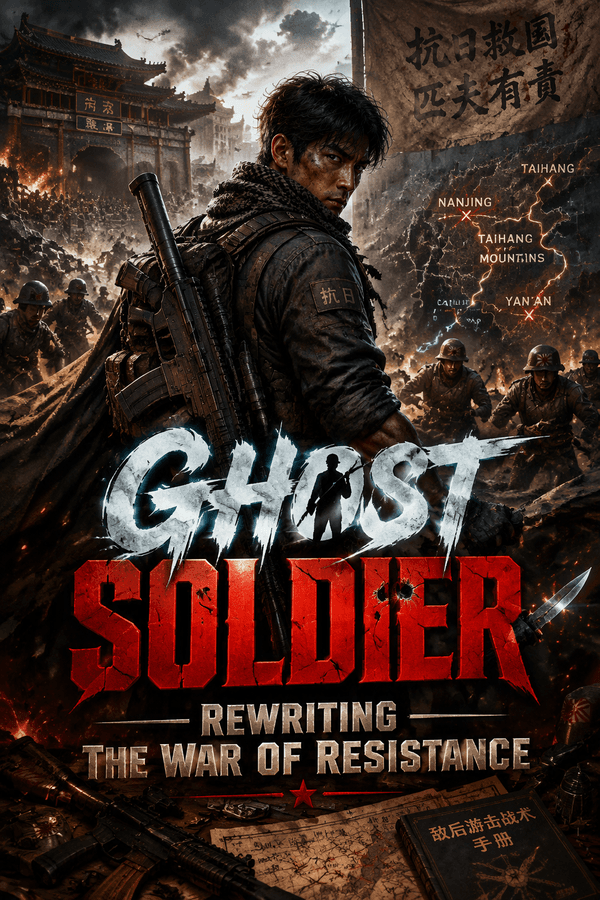
Leitao awoke slowly, feeling as if his head had been hammered by a heavy wooden club. A wave of throbbing pain surged through his mind, forcing him to instinctively strike his own head with his right hand in an attempt to alleviate the unbearable discomfort. As he propped himself up with his left hand, he felt something viscous and sticky. A thick, pungent scent of blood filled his nostrils. Startled, he opened his eyes and realized his left hand was covered in fresh blood. He looked around to find himself on a main street littered with corpses; the blood he had touched was flowing from a body nearby.
Just then, the persistent crackle of Type 38 rifle fire, characteristic of the Japanese Army during World War II, echoed in the distance. Leitao’s nerves tightened like a stretched wire. He snatched up his modified AK200 assault rifle and executed a swift tactical roll, leaping into an alleyway like a cheetah to take cover. His heart pounded violently, the rhythm roaring in his ears like a drum. While keeping a vigilant watch on his surroundings, he was filled with confusion. He had been at a border station in China, having just neutralized a rocket threat and sat down to rest—how had he ended up in this hellish place in the span of a heartbeat? And what was with the sound of those Type 38 rifles? His head spun as countless questions swirled in his mind, yet he could find no thread to pull.
Soon, his gaze fell upon the modified AK200 assault rifle in his hands. Knowing that in this unknown and dangerous environment, his gear was his lifeline, he began a meticulous inspection. He touched the weapon, the cold, hard metal bringing him a sense of reassurance.
Leitao expertly removed the magazine from the modified AK200 assault rifle with calm, swift precision. He was stunned to find it completely full. He remembered clearly that during the mission to escort the lithography machine back to China, he had engaged in a fierce firefight against foreign-backed armed groups. He remembered the rain of gunfire vividly; he had exhausted nearly all his magazines, leaving only one with about twenty rounds in the rifle. He frowned, wondering how this could be. Was this some mysterious change brought about by his displacement, or was some other unknown force at play?
He then checked the magazines in his tactical vest. With a faint zip, he opened the pouch, the sound cutting through the silence of the alley. He pulled the magazines out one by one, feeling the weight of the ammunition. Each was fully loaded. This felt increasingly impossible, as if some unseen hand were pulling the strings. His mind raced for a logical explanation, but none came.
He opened his tactical backpack, and the sight within astonished him further. Spare magazines were lined up like soldiers awaiting inspection. He picked one up to examine the contents: over 400 rounds of ammunition in total, including various armor-piercing, tracer, and anesthetic rounds. These would be invaluable in different combat scenarios, giving him tactical flexibility. He imagined these rounds turning into lethal meteors in the heat of battle, striking his enemies with devastating force.
Also present was an MP443 Grach Pistol with an 18-round magazine. He checked its components; the pistol was smooth and flawless, as if it had just left the factory. He had three spare magazines and 200 rounds of ammunition for it. Weighing the magazines in his hand, he felt a surge of confidence.
Beyond his firearms, there was a terrifyingly sharp combat knife. Its blade shimmered with a cold light, like a viper poised to strike. He reached out and gripped the hilt, a chill running from his fingertips through his entire body. He tightened his grip, appreciating the weapon’s immense potential. Its razor-sharp edge remained daunting even in the dim light; neither reinforced leather nor heavy metal could withstand its lethal blow. It would be his reliable weapon for close-quarters combat—a final line of defense to ensure his survival.
He also found his solar-powered high-intensity flashlight, a tool that had seen him through many difficult night missions, illuminating paths and helping him avoid deadly traps. There were four medical kits, each stocked with vital supplies—his assurance of survival should he be wounded. He verified that everything inside was intact. Finally, there were several rations, including compressed food bars and American-style canned meat and fruit. These would provide the necessary energy to endure the hardships ahead. He looked at the supplies, silently calculating how long they would sustain him.
After checking his gear, Leitao leaned against the alley wall, panting slightly. As his mind tried to organize the chaos, a gust of wind blew a newspaper to the mouth of the alley. His instincts flared, and he remained vigilant, listening to the direction of the Type 38 rifle fire. Confirming the immediate area was clear, he lunged for the paper. He was taken aback to see traditional Chinese characters on the front: it was an issue of the *Shen Bao*. The weight of the historic newspaper felt heavy in his hands.
He scanned the contents nervously, his eyes darting across the page while he remained alert to the sound of gunfire. As he read, a bold realization began to take shape. Based on the date, the reported events, and the surroundings, he had almost certainly been transported back to China during the War of Resistance. The city was, without a doubt, Nanjing City, just recently occupied by the Japanese Army. The gunfire he heard was likely the remnants of the Chinese garrison launching a desperate raid on a Japanese patrol, triggering a brutal reprisal.
Leitao rose carefully and peeked out at the street. It was littered with the bodies of civilians—old men, women, and children. Blood stained the earth, the scent of iron and gunpowder stinging his nostrils. He could reconstruct the carnage of the battle, his nerves tightening once more. The buildings on both sides of the street were in ruins, mere scorched skeletons of homes. A wave of grief and rage washed over him; he tightened his grip on his rifle, ready to face the challenge. Seeing the Republican-era clothing on the victims, he accepted the reality of his situation.