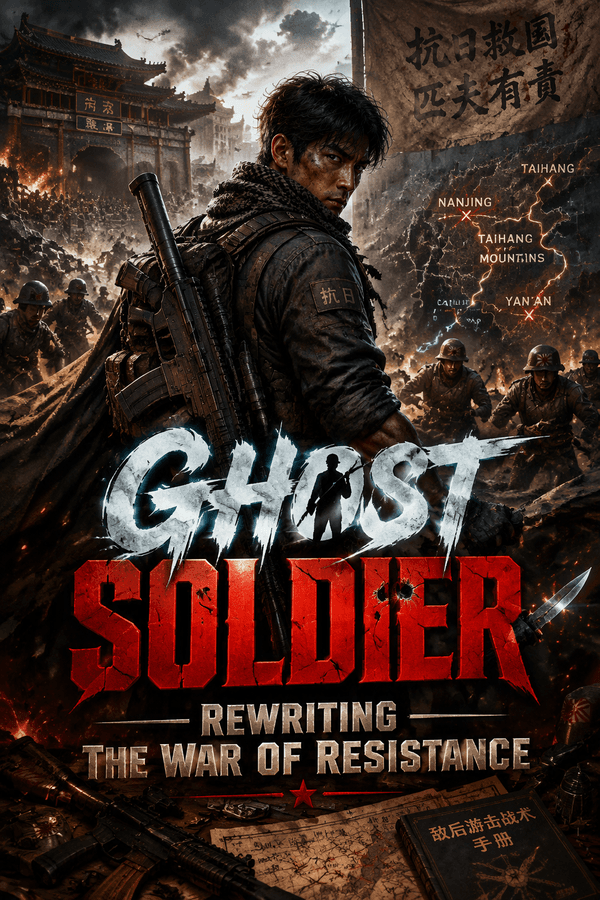
Leitao stood in the alley, his heart a turbulent mix of fury and a sense of duty. He knew he could not just sit and wait for death; he had to clarify the situation around him, especially to see what exactly had happened where those gunshots had rung out.
He decided to head toward the sound of the gunfire to investigate, and perhaps see if he could save anyone. Leitao took a deep breath, centered himself, and began to move with caution.
He used the alleyways beside the streets as cover, each step taken with extreme care. His feet landed lightly on the ground, making every effort to stay silent. He moved forward, sometimes hunched over, sometimes pressing his side against a wall, remaining vigilant at every moment.
As he neared a corner, Leitao stopped. He listened intently, and after confirming there were no unusual sounds, he slowly poked his head out just enough to observe the other side with his peripheral vision. Only after confirming it was safe did he quickly round the corner and continue his advance.
When he encountered buildings, he utilized their shadows to conceal his form. He wove through the darkness like a ghost. When close to a wall, he would press his back tightly against it, feeling the cold surface as if drawing a measure of safety from it.
As he advanced, Leitao constantly adjusted his tactical movements. At times, he crawled low, his body pressed flat against the ground, slithering forward like a snake. This posture allowed him to pass beneath lower obstacles without being detected. At other times, he would suddenly spring up, sprint quickly across an open stretch, and dive into a new position for cover.
Whenever he passed a window, Leitao would pause to carefully peer through the gap. If he spotted signs of the enemy, he would prepare for combat immediately; if not, he would press on.
During his infiltration, Leitao saw the civilians who had been struck down by the Japanese Army’s gunfire; they lay scattered across the ground, their blood staining the street. Leitao’s heart was filled with grief and rage, and his hatred for the atrocities committed by the Japanese Army deepened.
He then passed a large courtyard. When his eyes swept across it, the scene before him filled him with an absolute, searing fury. An infant was hanging by a rope tied around its neck from a tree, with a Type 38 bayonet driven into the ground directly beneath it. Beside the tree lay the naked corpse of a young woman. It was clear this had been a mother and daughter. Leitao could scarcely imagine the inhuman, barbaric torture they had been subjected to before their deaths.
Leitao clenched his hands into tight fists, his nails digging deep into his palms, his eyes burning with the fire of rage. He swore a silent oath that he would make these Japanese soldiers pay a heavy price.
He continued his cautious approach and finally reached a large building. He entered silently and climbed the stairs quickly. Every step was incredibly measured; he kept a constant watch for any movement around him. Reaching the top floor, Leitao set up a warning device at the top of the stairs so he would be alerted the moment an enemy approached.
He then crawled to the edge of the roof and lay low, concealing his body. From this vantage point, he could clearly observe the battle below between the Japanese Army and the remaining soldiers of the Guo'an Army.
The overcast sky seemed to be draped in a thick haze, so oppressive it was hard to breathe. Gunsmoke drifted on the wind, carrying a pungent, acrid smell that blurred his vision. The Japanese Army moved like a pack of rabid wolves, clad in khaki uniforms, wielding their Type 38 rifles as they pressed forward step by step. Their movements were uniform, clearly the result of rigorous training. Their eyes were cold and cruel, as if every life in this land were merely an object to be slaughtered at will.
The Japanese commander brandished his officer’s sword, shouting orders at the top of his lungs. The soldiers executed the commands swiftly, splitting into small squads to flank the Guo'an Army remnants from different directions. The Japanese artillery roared incessantly, shells raining down on the ruins around the soldiers, kicking up clouds of black smoke and debris. Shrapnel whistled through the air. The once-prosperous street was now riddled with holes, its crumbling walls swaying under the impact of the shelling. Broken bricks and tiles lay scattered, stained dark red by blood.
The remnants of the Guo'an Army, though few in number, stood as immovable as a fortress of steel. Dressed in tattered uniforms, their faces caked with dust and blood, their eyes burned with a determination and fearlessness that illuminated the dark battlefield.
They huddled together, using the shattered remains of walls to mount a stubborn defense against the Japanese onslaught. Every move they made was fueled by strength and courage; though their weapons were simple, their accuracy never wavered. They aimed calmly at the Japanese soldiers, each bullet carrying their hatred and resolve. Whenever a Japanese soldier got too close, they would not hesitate to throw hand grenades; the explosions echoed across the battlefield like a roar of defiance against the invaders.
Beside a collapsed building, a young soldier—his face still boyish—fought with raw courage. He gripped his rifle tightly, firing repeatedly at the Japanese, his resolute eyes telling the enemy he would never retreat. Beside him, an older soldier shouted words of encouragement, telling him not to fear and to fight bravely. Their figures seemed so small amidst the fires of war, yet they stood so tall.
The atmosphere on the battlefield was tense and tragic. Blood had dyed the earth, and bodies lay scattered everywhere. The wind howled past, as if mourning the brutality of the fight. Leitao was deeply moved. He knew he could no longer sit idly by. He had to come up with a plan, and fast, to help these brave Guo'an Army soldiers and deal the Japanese Army a heavy blow.