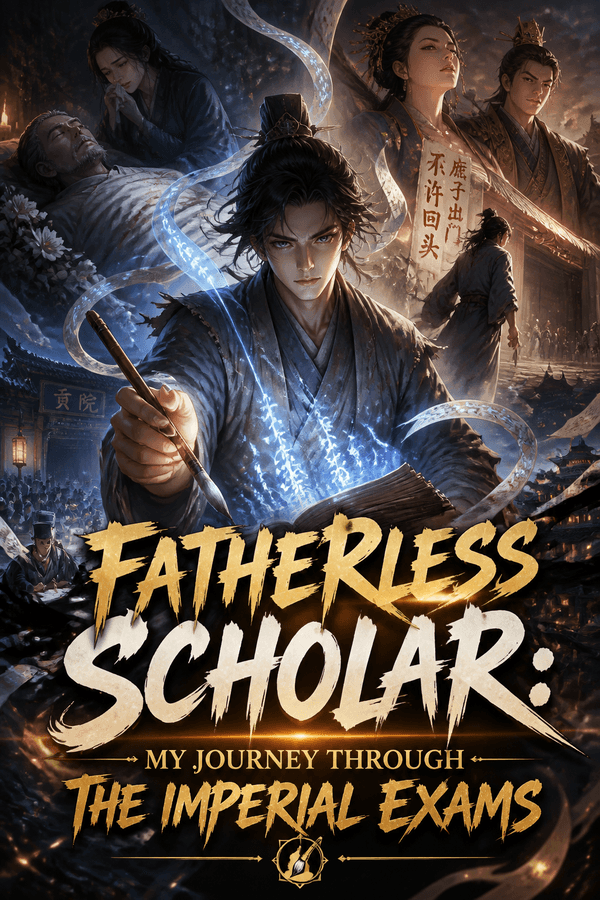
Lin Zezu walked along the hillside of Mao'er Ridge, where the lush green grass abounded with wild vegetables such as dandelions, goosefoot, purslane, and houttuynia.
Lin Zezu asked Fugui for the names of these wild vegetables.
Fugui scratched his head and said that he had eaten all of them and knew they were edible, but he had no idea what they were called. Lin Zezu had no choice but to drop the matter.
The hillside was quite vast, dotted with a few sparse pine trees holding the nests of turtledoves and magpies.
As he walked, Lin Zezu was pleasantly surprised to discover an abundance of wild bellflowers and bupleurum.
From the shape of the bupleurum leaves, he could tell that the leek-leaf and bamboo-leaf varieties prefigured most of them, leaving no doubt they were southern bupleurum.
The bellflower leaves were ovate-lanceolate with cuneate or nearly rounded bases and serrated edges, making them very easy to identify. In his past life, he had even dug up bellflowers on the mountains.
"Fugui, do you know what this is called?"
Lin Zezu pointed at a bellflower and asked.
"Young Master, I know this one. It's called bitter root; it tastes bitter and doesn't taste good."
Lin Zezu smiled and said nothing.
He knew the medicinal value of bellflowers well. They were mainly used to treat lung conditions by clearing lung qi, expelling phlegm and pus, and curing exogenous coughs, sore throats, and swollen tonsils.
Moreover, bellflowers were very easy to cultivate. Whether by transplanting or broadcasting seeds, the survival rate was extremely high.
Sowing seeds was as convenient as planting vegetable seeds.
He would choose seeds from plants over two years old—large, plump, and with an oily, shiny black surface.
After mixing the seeds with fine sand, he would scatter them evenly over the ridged soil and sweep lightly with a broom or tree branches until the seeds were just out of sight.
Then it was simply a matter of watering them and waiting for the seeds to sprout.
The roots of the bellflowers were also easy to process and could be harvested in both spring and autumn, though autumn harvesting was somewhat better.
After digging up the bellflowers, he would strip away the stems and leaves, wash off the mud, soak them in water, scrape off the outer skin, and dry them in the sun, and the job was done.
Bupleurum could also be harvested in the spring and autumn seasons. Processing bupleurum was relatively simple: just remove the stems, leaves, and dirt, and dry them in the sun.
Bupleurum was mainly used to treat colds and fevers. In this world, chills and fevers were ailments that could cost a person their life at any moment; a slight misstep and it was all over.
Lin Zezu thought to himself that he should stock up on more bupleurum at home in the future, lest he be caught empty-handed when a cold or fever struck.
Lin Zezu ventured a bit deeper into the mountains and discovered many wild tea trees.
The tea trees grew at varying heights, uneven and scattered across this hillside of roughly a hundred mu.
Now, right in the third month of the year, was the prime season for picking tea.
After leaving the manor, drinking tea again would otherwise be a luxury, but these tea trees provided a timely solution to an urgent need.
In his past life, his hometown village had also been nestled in the mountains, so Lin Zezu felt a natural affinity for Mao'er Ridge.
Back in his previous life, every household in the village knew how to pan-fire tea.
After picking the spring tea, they would dry the moisture from the fresh leaves in the air.
Then, they would heat an iron wok, first fixing the green in the tea leaves, rolling them into shape, and then dividing them into pans for gentle rolling.
Once the shape had stabilized, the rolled tea leaves were placed on sieves and roasted gently over a charcoal fire.
This step fixed the shape and enhanced the fragrance, ensuring the leaves were thoroughly dried and set while bringing out the tea's aroma.
After roasting, the tea leaves were completely crisp and dry, ready to be sealed in tea canisters.
Autumn tea required much more effort because the autumn leaves were thick and fleshy. They needed to be boiled in water, allowed to air dry, and then piled up for fermentation.
During the fermentation process, the piles had to be constantly turned over to prevent mold and spoilage.
Once fully fermented, the leaf mass was placed into molds and pressed down with heavy weight.
The square ones were called tea bricks, while the round ones were called tea cakes.
After the tea bricks and tea cakes were made, they were placed in a room to air-dry and ventilate, during which time a secondary fermentation took place.
These were the things commonly referred to as black tea or post-fermented tea.
Black tea had a bright red liquor, a rich and mellow taste, and left a lingering fragrance in the mouth after drinking.
Thinking of this, Lin Zezu felt a surge of joy.
Based on his understanding and knowledge of this world, black tea did not exist yet—only green tea.
However, the so-called green tea produced here was not refined enough. Regardless of the harvesting season, the production process, or the tea's aroma, it fell far short of his past life.
If he processed the spring tea, even if he couldn't sell it, he could keep it for his own consumption or use it as gifts for social favors, which would save him a massive expense, since tea in this world was not cheap.
After wandering around the hillside for a while, it was approaching noon.
Lin Zezu reluctantly returned to the old estate, greeting the villagers along the way as usual.
Since it was just the time for cooking meals, Lin Zezu managed to avoid running into any of the neighborhood gossips, which made his walk back much more relaxing.
Just as Lin Zezu stepped through the main gate, he ran straight into Steward Zhao, who was heading out. He stepped aside and greeted Steward Zhao with a bitter expression.
"Uncle Zhao, are you heading out on business?"
Steward Zhao glanced at Lin Zezu, who was caked in mud and wearing a woebegone look. He understood the situation instantly, but his expression remained all smiles.
"Fourth Master, you're back from your outing! The women in the kitchen said lunch will be ready soon. If you're hungry, you can have Fugui go to the kitchen to grab a few steamed buns to tide you over first!"
"No need, Uncle Zhao. As you can see, I'm covered in mud and a bit filthy. I'll go back to my room to wash up first, and won't hold up your business outside."
The two brushed past each other with smiles.
Upon returning to the West Side Room, Fugui quickly fetched water for washing. Lin Zezu thoroughly scrubbed himself clean and changed his shoes. Just as he sat down to flip through a few pages of a book, Fugui brought over the meal. The lunch was exceedingly simple: three vegetable steamed buns and a bowl of rice soup.
After finishing lunch, Lin Zezu did not take a nap as he usually did. Instead, he planned to head into town to the Songshan Bookstore to see if he could buy any books on the history or laws of the State of Wu.
Since he couldn't go back, he had to live well in this world.
In the front courtyard, aside from Ping'an the gatekeeper, Lin Zezu and Fugui saw no one else.
Less than half a li east of the estate gate, they hit the country road leading north to Songshan Town.
Over the past few years, due to the original owner going to the private school in town, Lin Zezu knew this country road backward through his memories.
Passing through the "cat's rump" of Mao'er Ridge, a straight path led directly to Songshan Town.
Without a word along the way, half an hour later, master and servant arrived in Songshan Town.
Though called a town, it consisted of little more than a single main street.
Following the death of Lin Shitong, his descendants were required to observe a one-year period of mourning, so Lin Zezu had no intention of showing his face at the Songshan Private School today.
The only bookstore in town was the Songshan Bookstore. The original owner had visited a few times before, knowing only that the proprietor had the surname Wang, was rather plump and short, and smiled in a way that made his eyes crease into two narrow slits.
At the entrance of the Songshan Bookstore, Lin Zezu told Fugui not to follow him inside and to go wander around on his own.
With that, Fugui handed his purse over to Lin Zezu. Lin Zezu took the purse, casually plucked a dozen copper coins, and gave them to Fugui, who turned around and skipped off in high spirits.