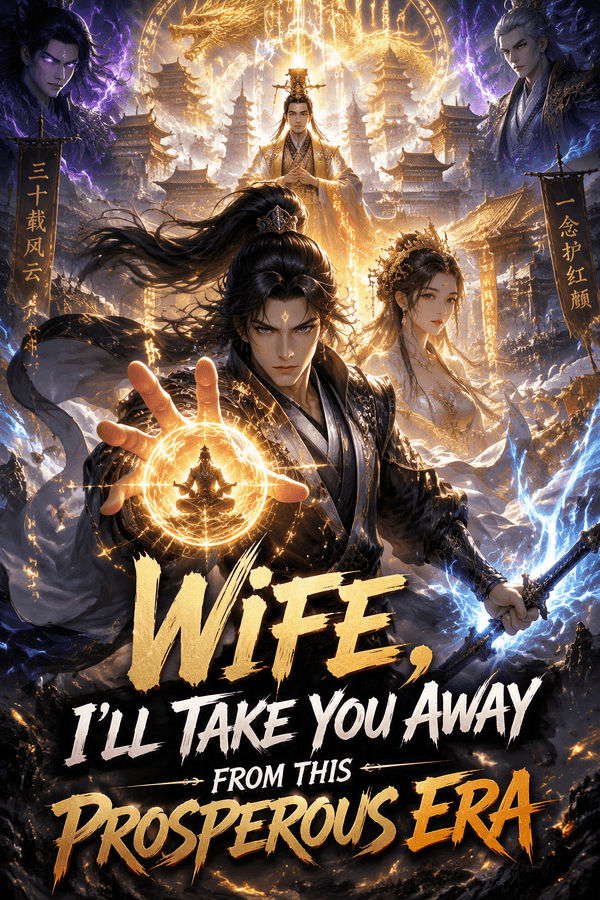
Just as Zhao Yi emerged from seclusion after healing his wounds, inside the imperial palace, within the hall where the emperor handled state affairs, a young emperor sat upon the dragon throne at the upper end of the room. He was Wang Zhenggan, the forty-fifth emperor of Zhao Country, bearing the reign title of Emperor Zhengde.
Emperor Zhengde sat upright on the dragon throne, clad in a magnificent imperial robe embroidered with intricate dragon patterns that shimmered with a dazzling golden light. His features were handsome and his contours well-defined, his brows revealing an aura of majesty and wisdom. At this moment, he was intently reviewing a towering stack of memorials, pondering from time to time or knitting his brows slightly as his vermilion brush traced across the paper without pause. One could tell he was an emperor who attended to everything personally, diligent in governance and devoted to his people.
Wang Zhenggan had ascended the throne at the age of nine, and upon turning twenty this year, he had finally begun ruling in his own right. Previously, his mother, Lady Song—now the Empress Dowager—had acted as regent on his behalf. The Empress Dowager had appointed her elder brother, Song Guangming, as the chief grand councillor. The Song siblings had seized control of the imperial government, promoted favorites and relatives, and deceived those above while blinding those below, plunging the entire imperial court into a state of foul chaos. This year, having reached the age of capping, Wang Zhenggan was entitled by ancestral precedent to formally take the reins of government. Yet the Empress Dowager and the imperial uncle were unwilling to relinquish power, stirring up a massive storm within the imperial court. Led by Shen Bi, the imperial tutor, and Grand General Chen, civil and military officials alike banded together to persistently contend with the Song siblings, until the Empress Dowager finally returned power to the emperor and withdrew behind the scenes.
For over a decade of regency behind the bamboo curtain, the Empress Dowager had driven the populace to destitution. The Song family bought and sold official posts, forming cliques for private gain within the court, which brought extreme turmoil to all of Zhao Country. In certain regions, bandits ran rampant, with robberies and rebellions erupting one after another, while frictions along the borders were likewise unceasing.
To the east of the Houtu Domain lay the vast Heitu Domain, home to eight mortal nations of varying sizes, possessing strength far surpassing that of the Houtu Domain. The smallest nation in the Heitu Domain, known as the Tianqi Country, bordered Zhao Country. Although it was the smallest nation in the Heitu Domain, its overall national strength was vastly superior to that of Zhao Country, and it frequently took advantage of the latter.
Straddling the border between Tianqi Country and Zhao Country was an endless, immense mountain range stretching for tens of thousands of miles, named the Changheng Mountains. Towering into the clouds, the Changheng terrain was perilous, shrouded in mist year-round, and rarely visited by mortals. The mountains were home to numerous beasts as well as Spirit Beasts, which frequently raided towns and villages at the foothills, causing casualties among the people. However, the cultivation levels of these Spirit Beasts were generally low; most were primary Spirit Beasts that had just awakened their spiritual intelligence, roughly equivalent to the mid and late Qi Condensation stage. Legend had it that deep within the mountains dwelt even higher-grade Spirit Beasts, the strongest of which could rival those in the Nascent Soul stage. Every few years, the immortal cultivation sects of various nations would dispatch people into the mountains to suppress and cull the beasts, mitigating the threat they posed to the mortal realm.
The Changheng Mountains also served as the natural border between Zhao Country and Tianqi Country. It was precisely because of the obstruction provided by the Changheng Mountains that Tianqi Country was unable to act rashly. On the border between the two nations stood an important strategic pass known as Tianfeng Pass. Behind the pass lay a large city; merchants and travelers entered the gate from here, passed through a long canyon, and finally reached the territory of Tianqi Country. This pass was also the sole route for commerce and communication between the two countries. Zhao Country stationed heavy troops here to guard against incursions by Tianqi Country.
Half a year ago, the Tianqi Country side at Tianfeng Pass notified the Zhao Country side that five military horses had gone missing. Suspecting that someone from Zhao Country had stolen them, they demanded to enter the pass to investigate, accompanied by a force of thirty thousand elite troops arrayed before Tianfeng Pass. Because Zhao Country bore the mission of defending against beast tides, and its people prized martial arts—with nearly everyone practicing combat—its military might was relatively strong. However, Zhao Country did not produce fine steeds, and most military horses had to be purchased from neighboring countries. Consequently, neighboring countries exercised extremely strict control over horses, costing Zhao Country a considerable amount of wasted wealth in acquisitions. The horses of traveling merchants were required to pay taxes when passing through the Tianqi gates, failing which they were denied passage. Let alone five horses; even a single horse attempting to slip secretly into the pass would likely have been intercepted by Tianqi Country long ago. Was this not a blatant, trumped-up charge intended to bully Zhao Country?
When the news reached the imperial court of Zhao Country, the Empress Dowager and imperial uncle Song Guangming were frightened out of their wits. Terrified that Tianqi Country would launch an invasion, they hurriedly dispatched envoys to sue for peace, while their favored officials boasted endlessly about the might of Tianqi Country, claiming that if they attacked, Zhao Country would soon be finished. This filled several loyal and upright ministers with extreme indignation, as they insisted that if war came, they must fight without making any concessions. Meanwhile, the common folk of Zhao Country also learned of the matter, and the majority cried out that they feared no battle, eagerly enlisting in the army to fight for their country.
Feng Wuxi, the garrison general stationed at Tianfeng Pass in Zhao Country, rejected the adversary's unreasonable demands. In response, Tianqi Country reinforced its troops by another twenty thousand to pressure Zhao Country. Unfazed, Feng Wuxi deployed his forces in a standoff against them, and when Tianqi Country realized it could gain no advantage, it withdrew its troops. Only then did the entire court and country of Zhao Country heave a sigh of relief.
Truly, internal troubles and external threats intertwined, and a storm was gathering on the horizon.
The emperor, who had ascended to personal rule amidst such circumstances, was deeply aware of his immense responsibilities. He resolved to employ the virtuous, eradicate court corruption, suppress bandits, overawe the borders, and restore a clear and bright universe to the subjects of the imperial dynasty.
Yet a memorial before him now caused the young emperor to knit his brows, leaving him with a foreboding sense of unease.
Anbei Prefecture was the province where Tianfeng Pass was located. A memorial submitted by Chen Yanding, the prefect of that region, reported the phenomenon of children disappearing across several subordinate counties and districts. The prefect's brushstrokes were heavy, and between the lines he revealed his worry and perplexity over the situation.
Prefect Chen stated in the memorial that children had gone missing in the subordinate counties. In several remote villages, dozens of children had vanished within the span of a month. Zhao Country suffered from a lack of population growth, and promoting childbirth was a state policy; the disappearance of dozens of children was already a major incident.
Prefect Chen had personally dispatched men to investigate these counties and districts, yet they returned completely empty-handed. The children seemed to have vanished into thin air, leaving no trace or clues to follow. With no other option, he had reported the matter to the imperial court, leaving the decision in its hands. At the close of the memorial, Prefect Chen attached several rumors he had heard: some claimed that Spirit Beasts had devoured the children, others that practitioners of dark arts had abducted them, and still others that it was a warning from the heavens...
Hmph, such claims were likely insincere! If this matter were not handled swiftly, who knew what other strange mischief might arise in the future!
"This matter must be discussed with the Teacher and the Grand General before a decision is reached," the emperor murmured to himself, immediately shouting toward the entrance, "Xiaoxizi!"
"Older Brother Emperor!" At the same time, a voice resembling the singing of an oriole rang out at the doorway.